
I was on a call recently, helping someone prepare for a senior leadership interview. They are currently an assistant head, and this would be their first step into a deputy-level position. Talking through their current role, they mentioned something they had only realised while drafting their letter of application: nobody else in the building could do what they do. They said it with a degree of pride, and arguably rightly so. They had been there in the school’s early stages, had built much of what they now ran, and had built it well. The more we spoke, the clearer it became that their role had largely grown around them and their skillset.
For the candidate, this provides excellent ammunition for their application and interview. For the school they are about to leave, it is a problem. If the interview goes well and they move on, there will only be a few months to orchestrate the documentation and handover of something complex enough that it took years to build. In the best-case scenario, those taking over the responsibilities will be current colleagues who have seen the systems work but know nothing of the back-end that underpins them. In the worst, the process will simply produce a set of static documents that someone who isn’t even in the building yet will need to decode when they arrive.
A handover document should be a postscript, not a manual. Its proper contents are personal: the history behind a decision, the parent who needs careful handling, the things to watch for in the first term, and some links to make important resources easy to find. Everything structural, from the policies and processes to the systems that run them and the data that inform them, should already live in one authoritative place and be understood by more than one person who is staying. When that is true, the handover can be short and effective. When it is not, the school is left trying to transfer years of capability through a document, and discovers how little survives the upheaval.
Too many schools inadvertently set themselves up for the second outcome. Systems that grow organically result in information being duplicated across spreadsheets, shared drives and personal folders, and the ability to do anything with it often concentrated in one person. This is particularly common in the founding years and after periods of rapid growth or change. Leaders seeking to create resilient and responsive institutions need to make sure it is the other way round: concentrate the content, and distribute the capability.
Sources of truth and pairs of hands
For the purposes of this article, a source of truth is any version of a policy, process or dataset that someone treats as authoritative and works from. A copy, summary or translation that points back to the original is not a separate source; one that can be edited or reinterpreted independently is. A pair of hands, meanwhile, is someone who can actually run the system, from keeping the source current to acting on it, judgement calls included, without having to ask anyone else.
Taken separately, these concepts are nothing new, nor are the ideals for each. A single source of truth has long been a principle of information management, and key person dependency (where only one individual in the organisation can do a job) is a risk familiar to anyone who has led a team or completed a rudimentary management course. What schools, and many other organisations, rarely give enough thought to is where the two intersect. In my experience, this is precisely where systems hold or break.
Map the number of sources against the number of pairs of hands, and you get that classic staple of the consultant’s toolkit: a two-by-two grid. Each of its four quadrants has a recognisable character, which I like to describe through a musical analogy. Only in an ensemble is the departure of a valued member of the team likely to be an inconvenience rather than a crisis. The other three quadrants each have a different weakness, and need a different fix.
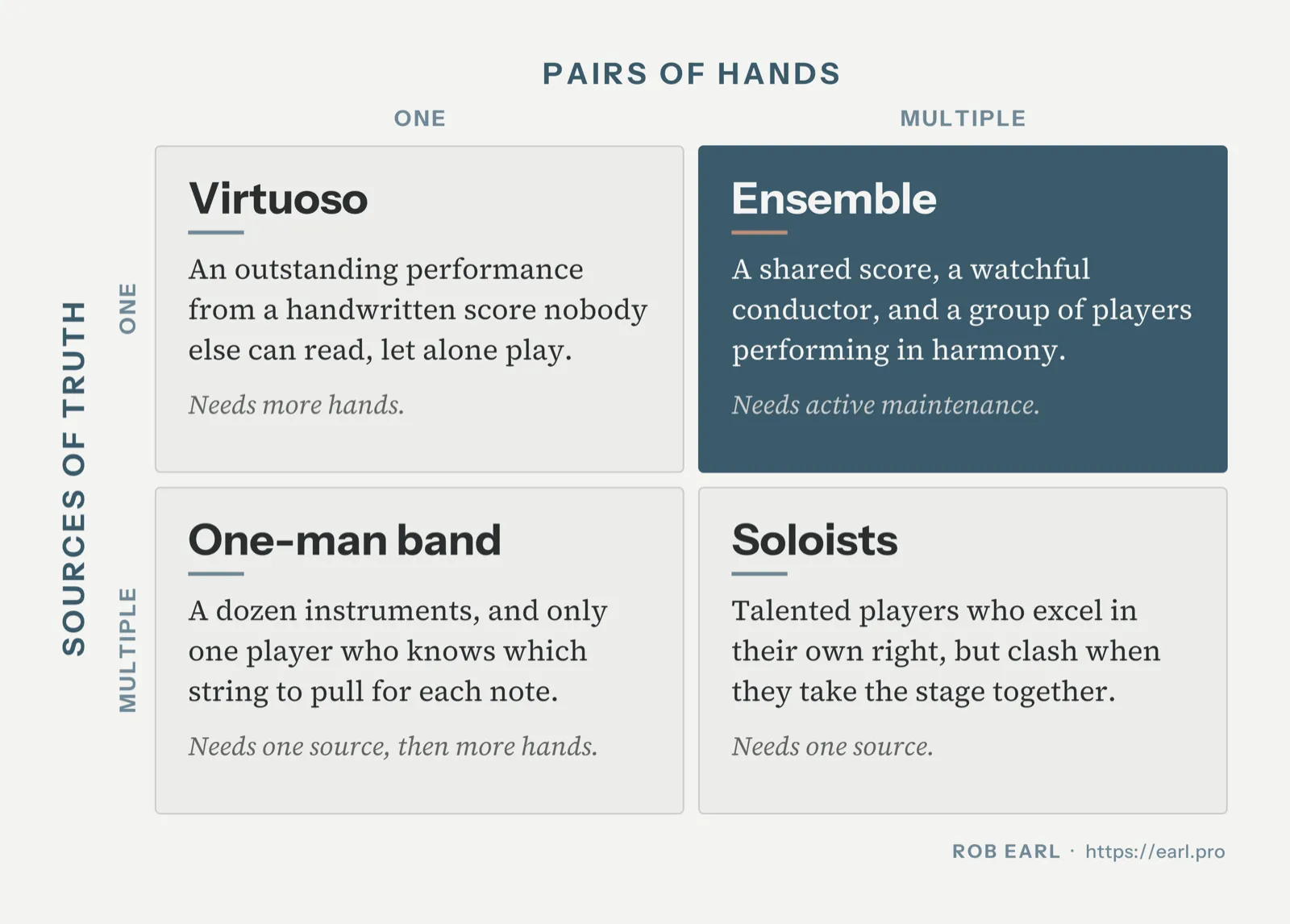
The grid applies to each system separately rather than to the organisation as a whole, and any of them can shift quadrant as people come and go. Most schools I’ve worked in run attendance and punctuality as a well-oiled ensemble. On the other hand, just about every timetabler I’ve met (myself included) believes that the job can really only be done well alone, and that kind of thinking often creates virtuosos. The examples that follow are drawn from my own experience, anonymised and in places combined.
The virtuoso: applauded every night, until the night they don’t turn up
The person on my call is a virtuoso, and founding schools produce them almost inevitably. As I have written before, a school in its founding years has no institutional memory to draw on. The detail of how its systems work, and why they were designed that way, tends to live in the heads of the people who built them rather than on paper. Nobody decides that one individual will be the only one who understands the timetable, the admissions pipeline or the assessment calendar. The dependency accumulates, one sensible decision at a time, because in a small team there is no obvious reason to do it any other way.
The virtuoso quadrant is the hardest to see from the outside, and the least often complained about from the inside, because it looks healthy. There is one source of truth, and the work is generally done to a standard that at least ensures everything keeps ticking along. If it weren’t, the individual concerned would have found themselves under pressure to share or hand over the responsibility long before any critical failure. But whatever documentation exists on paper is usually written in its author’s own hand: organised the way they think, full of shorthand that makes perfect sense to them and to nobody else, missing things they see as obvious, and hard, sometimes impossible, to follow without what they carry in their head.
The virtuoso is usually admired, often deservedly, and colleagues defer to them precisely because they know what they’re doing. The risk stays latent until they are ill at the wrong moment or hand in their notice, at which point the school discovers that something it had been treating as an asset was also a single point of failure. I have been that single point of failure more than once myself. When I left one senior role, the person taking over one significant aspect of it from me was already in the building. We allowed six months for the handover, with them shadowing me for much of it, and still there were things they needed to check with me after I had departed.
The fix is more hands, not more documentation. Rewriting the score more legibly helps, and so does a handover document, but neither can capture what never made it onto paper, least of all the judgement that is usually most of what the virtuoso does. Nor is shadowing enough: judgement is built by making (or at least sharing in) the calls, not by watching someone else make them. What the school needs is a second person who has actually done the work, first under supervision and then without it, well before anyone is thinking of leaving.
That second person does not need to be able to do the whole job. What matters is that each major system has more than one pair of hands, and those hands need not all belong to the same colleague. Trying to train a single understudy for an entire role quickly turns into succession planning by way of role duplication, and leaves the school paying two people to do one job. The question to ask of any system worth worrying about is whether the work could be done by the team next week, competently, without its owner and without contacting them.
Soloists: brilliant in isolation, discordant together
Soloists are at their best when playing from their own scores. One at a time, with everyone else playing in harmony around them, that works well. Their leadership elevates the performance and gives everyone else something to rise to. The problems start when several of them choose their moment at the same time, taking the same passage in different directions.
This can happen at any scale, from the leadership of a section with dozens of staff down to individual teachers designing their own assessment schemes. Because each version works on its own terms, it can go unnoticed for years, and without good quality assurance and monitoring in place, the divergence can continue to grow. It only becomes audible when the processes meet and generate conflicting outcomes. Even then, it takes a difference big enough, and stakes high enough, to provoke a response: usually a complaint from a parent, student or member of staff, a challenge from a governor or a recommendation from an inspection.
A version I have seen multiple times rears its head when students progress through the phases of an all-through school. A behaviour policy, or even a statement of values, is articulated differently for the Early Years, Primary and Secondary sections. The intention is entirely sound: to make it accessible and meaningful for children of different ages. But without careful coordination, each rewording carries its own interpretation. Over time, through successive iterations overseen by changing teams, those interpretations drift apart. A child is comfortable with what is expected of them and understands what they need to do to succeed. Then they move up a phase and find that the rules have suddenly changed. Parents with children in more than one phase tend to see the gaps first.
The fix here lies in a distinction between adaptation and reinterpretation. Adaptation changes the wording; reinterpretation changes the expectation. The first is the same score played in a different arrangement, and it is exactly what a school should do for its younger students, or for families whose first language is not the school’s. The second is soloists. A simple test is whether each version can be mapped back, line by line, to a single source. Students can play a role here: if your Sixth Formers read the Early Years value statements, would they recognise them?
There is a subtler version that involves no duplication or adaptation at all. On the surface, there appears to be a single source of truth that everyone understands. The problem is, that source of truth contains wording that is open to interpretation to the point that different readers may take very different things from it. In practice, this is no different to multiple sources, and groups or individuals will act as though they are not reading from the same score.
Take one school I have knowledge of, where predicted grades for university applications were set by teachers working from the same written guidance: be optimistic, but realistic. Some read that as licence to be aspirational, and predicted some students high grades that there was no evidence they were on course to achieve. Some used the prediction as a lever, a carrot or a stick to motivate the student. Others were, by any reasonable measure, too harsh. Everyone had the same instruction, but it contained two adjectives pulling in opposite directions, and each teacher weighted them differently. One email had become several sources of truth.
The solution here is to remove the ambiguity, either by rewording the source so that it is less equivocal or by explaining exactly what it means. In the predicted grades case, ‘realistic’ was defined to mean that the assessment record contained evidence the student was capable of producing work at the level of the prediction, even if they had not done so consistently. ‘Optimistic’ meant that a teacher on the fence between two grades should go for the higher one. It did not mean turning a clear B into an A for the sake of generosity, or because they were hounded by the student or their parents. Where a judgement resists definition, worked examples can do the same job: precedent, shared across the people making the call, shows what the instruction means in practice.
Whatever the cause, the soloists quadrant is perhaps the hardest to fix culturally, because the people involved generally believe, often with good reason, that they are doing the right thing. Bringing the divergent versions together almost always means compromise for some or all: someone’s wording, someone’s assessment scheme, someone’s long-established way of doing things will not survive the process intact. With the phases of an all-through school, it usually leaves at least one section feeling sour, and beholden to the priorities of another.
Getting it right needs a senior leader willing to make the call, explain it, and accept that not everyone will thank them for it. Sometimes the downsides of ‘fixing’ a difference outweigh the benefits, or the divergence is simply too ingrained to be worth unpicking. In these situations, the right call may be to leave it alone.
The one-man band: in sync until someone else bangs the drum
The same predicted grades had a second problem. First, they were entered into the university applications platform by teachers, so that students and parents could see them and they could be included in applications. Then they were copied into the MIS, for central recording (as the applications platform did not have a direct integration with the MIS). And then they were extracted to a shared spreadsheet, for analysis by the school leadership. Three sources, each with a legitimate purpose, held in alignment by one person: the head of university guidance, who coordinated every change through an agreed process.
Mostly, it worked. But from time to time someone would change a grade in one system on their own initiative, bypassing the process. Usually it was someone with a high level of access: someone senior who could edit the shared spreadsheet, or an IT technician making changes at the behest of a teacher in a rush. The sources would then be misaligned until the discrepancy was spotted. It was the equivalent of running up behind a one-man band and banging their drum just as they were about to blow into their harmonica. Suddenly, the sound didn’t match the score. On at least one occasion, an amended transcript had to be sent to a university, correcting an error that arose from the predictions being taken from an out-of-date source.
Access is not capability. Several people could change the grades in different systems. Only one was doing so in a way that kept them consistent across sources. Edit access without an understanding of the whole does not add a second pair of hands. It adds soloists to a one-man band: several sources, several people editing them, and still only one trying to reconcile them.
The school’s eventual fix was to lock down all three systems and create a form for grade changes after the initial data entry. Only the university guidance team could act on it, so every change came through one channel and was applied across all three sources by people who understood how they fitted together. In effect, the form became the source of truth, and the team, rather than one person, became the hands. The lesson travels beyond predicted grades. Start with the source, so that there is one thing for new hands to learn rather than several, and nowhere left for a well-meaning drummer to strike. And do it while the person holding everything together is still there, because they are usually the only one who knows which version is right.
An ensemble is maintained, not achieved
The policy package I described in an earlier article is an attempt at creating an ensemble for one domain. Each element of a policy lives in one place, every other element points back to it rather than restating it, and staff are trained to use it rather than simply sent it. In the school where I put the policy and process layers in place, the system is still in use, as far as I know, some time after I left. A system that keeps running after its architect has gone is the clearest sign of an ensemble.
But an ensemble is not a resting state, and it can decay in both directions. One person gets better at the work than the others, the others defer, and within a year or two they have stopped doing it altogether: the ensemble has become a virtuoso. Or people start keeping their own copies “just for convenience”, and the single source of truth stops being single: the ensemble has become soloists. Keeping an ensemble together is the conductor’s job, and in a school the conductor is the senior leader responsible for that area. Their role is less to play a part than to watch for drift: rotating who does the work, and checking periodically that the source everyone thinks they use is the one they actually use.
Picking up the baton
Every school loses people, but international schools lose them on a timetable. With two- and three-year contracts the norm, departures of key staff are not occasional events but an annual certainty, and some will always land at the worst possible moment. Succession planning tends to focus on senior posts, but the roles that actually stall a school when they fall vacant are often overlooked: the teacher who writes the timetable, the head of year who oversees the sanctions system, the coordinator who runs the co-curricular programme. The answer is not an understudy for each of them, but making sure that every system they run has more than one pair of hands. How many is enough depends on how critical the work is, how often it happens and how long it takes to learn.
Which brings me back to the person I was helping prepare for their interview. Making sure others could run what they built was never really their job; it belonged to the senior leaders above them. In the senior role they are applying for, it becomes theirs. “Nobody else can do what I do” is a good answer to a question about their current role. It would be a worrying answer to a question about how they will lead the next one. The better answer, and the one I would want to hear from a candidate for senior leadership, is the system they built and the people they made sure could run it without them.